
From Global Climate Commitments to Campus Action: The Role of Green Audits

Understanding the role of green audits in advancing sustainable campus initiatives
- February 12, 2026
- Abhiram GS
Climate change is no longer a distant scientific projection — it is a lived reality shaping economies, ecosystems, and everyday life. From rising global temperatures and erratic rainfall to increasingly frequent extreme weather events, the signals are visible across regions and sectors. These changes disrupt food systems, strain public health, damage infrastructure, and threaten long-term economic stability.
Scientific evidence attributes much of this warming to increased concentrations of greenhouse gases such as carbon dioxide and methane, released through fossil fuel combustion, industrial activity, and land-use changes. By intensifying the natural greenhouse effect, these emissions are accelerating long-term climatic shifts.
Addressing this challenge demands coordinated action — globally, nationally, and at the institutional level.
Global and National Climate Frameworks
International efforts to address climate change are guided by frameworks such as the United Nations Framework Convention on Climate Change (UNFCCC) and the Paris Agreement. Under the Paris Agreement, countries outline their climate goals through Nationally Determined Contributions (NDCs), reflecting their capacities and development priorities.
In India, climate action is supported through policy instruments including the National Action Plan on Climate Change (NAPCC) and various national missions focused on renewable energy, energy efficiency, water conservation, and sustainable development.
While these frameworks primarily guide governments and industries, their influence extends to institutions — including universities and colleges — that play a meaningful role in resource consumption and environmental stewardship.
The Role of Higher Educational Institutions
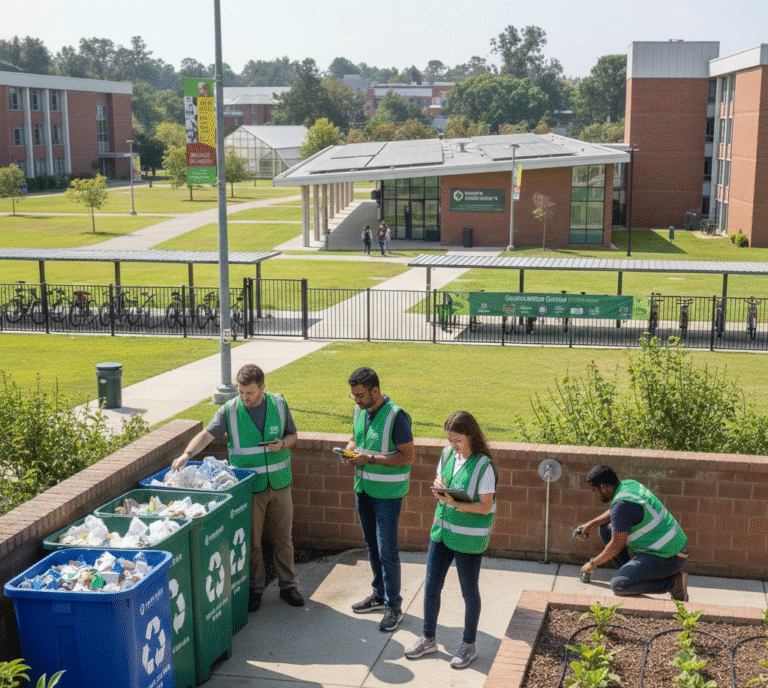
University campuses function as small, self-contained ecosystems. They consume electricity and water, generate waste, operate transportation systems, and manage buildings and sanitation facilities. These activities contribute directly and indirectly to environmental impact.
In addition, educational institutions shape future professionals, policymakers, and citizens. Their operational practices therefore carry both environmental and educational significance.
To better understand and manage their environmental performance, many higher educational institutions undertake structured sustainability assessments — one of the most practical being the Green Audit.
Sustainability begins with Measurement: Green Audit
A Green Audit for universities and colleges is a systematic evaluation of an institution’s environmental practices and resource utilisation.
It typically examines areas such as:
- Energy consumption and efficiency
- Water usage and conservation practices
- Waste generation and management systems
- Sanitation and hygiene infrastructure
- Campus greenery and biodiversity
- Environmental awareness initiatives
The purpose of a campus green audit is not merely documentation. It aims to identify patterns, measure resource use, highlight inefficiencies, and recommend practical improvements.
Unlike large-scale Environmental Impact Assessments (EIA), which are often project-specific and regulatory in nature, green audits generally focus on ongoing campus operations and sustainability performance.
Contribution to Climate Mitigation and Adaptation
Although a green audit alone does not eliminate emissions, it supports climate action in meaningful ways.
Supporting Mitigation
By analysing energy and waste data, institutions can:
- Identify opportunities for energy efficiency
- Explore renewable energy options
- Improve waste segregation and reduce landfill contribution
- Optimise water and electricity consumption
Such measures can contribute to lowering indirect greenhouse gas emissions over time.
Supporting Adaptation
Green audits also encourage:
- Water conservation measures
- Improved indoor environmental quality
- Better waste and sanitation systems
- Strengthened environmental risk awareness
This enhances campus resilience and long-term sustainability.
From Assessment to Continuous Improvement
A structured campus sustainability assessment enables institutions to:
- Establish baseline environmental data
- Track performance over time
- Identify operational gaps
- Develop corrective and preventive actions
- Promote environmental awareness among stakeholders
Importantly, green audits are most effective when integrated into a cycle of periodic review and continuous improvement rather than treated as one-time exercises.
The Strategic Value of Green Audits for Institutions
Many educational institutions undertake green audits to:
- Strengthen environmental governance
- Support sustainability reporting
- Enhance transparency
- Align with broader sustainability initiatives
- Prepare for accreditation or ranking processes where environmental practices are evaluated
While specific regulatory requirements may vary, structured environmental assessments demonstrate institutional commitment to responsible resource management.
Bridging Policy and Practice
Global climate agreements establish direction. National policies provide frameworks. However, measurable environmental progress depends on implementation at operational levels — including campuses.
Green audits offer a structured approach for translating sustainability intent into data-driven action. By systematically evaluating resource use and environmental practices, educational institutions can make informed decisions that reduce environmental impact and strengthen long-term sustainability.
In this way, campus-level assessments serve as an important link between international climate dialogue and practical, on-ground institutional responsibility.
Post Tags :
About Us
We are a team of certified professionals with expertise in green audits and Hygiene Rating Audits, driven by industry standards and sustainability best practices. Our comprehensive inspection services help institutions and businesses improve environmental performance, enhance hygiene compliance, and align with national and global standards.