Why Green Audits are Increasingly Becoming a Measure of Institutional Maturity
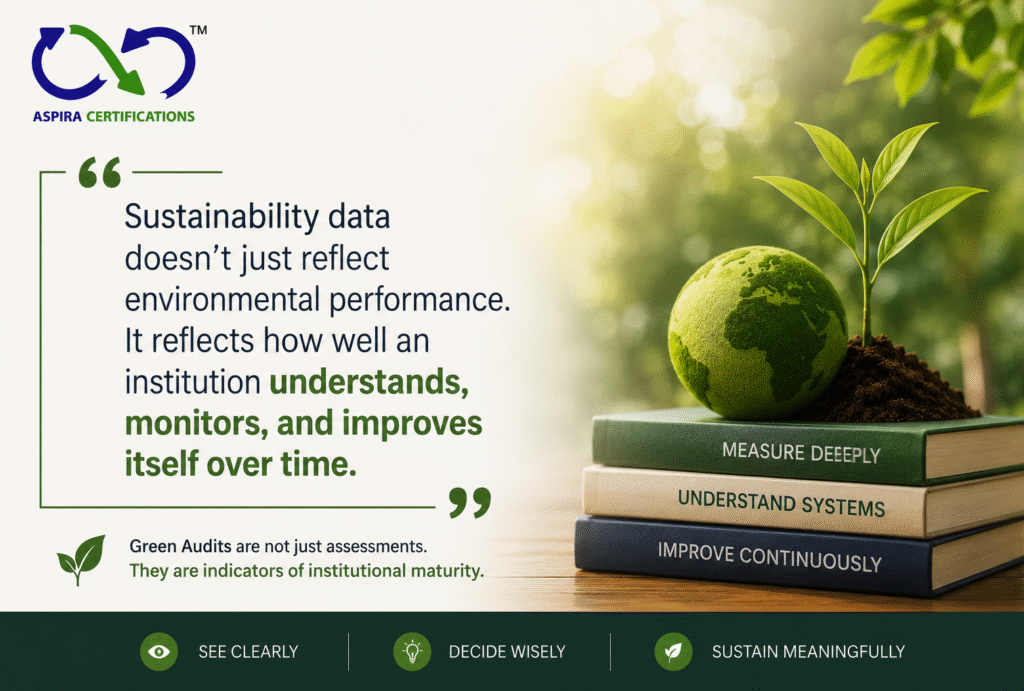
How Green Audits are becoming indicators of governance and institutional effectiveness.
- May 30, 2026
- Karthiga S
Most institutions believe a Green Audit measures sustainability performance.
Surprisingly, that is only part of the story.
What makes Green Audits interesting is not simply what they reveal about sustainability, but what they reveal about institutions themselves.
Over the years, a pattern has become difficult to ignore. Institutions with similar infrastructure, similar student strength, and often similar sustainability initiatives frequently produce very different outcomes. Some campuses steadily improve. Others continue to encounter many of the same observations year after year despite genuine effort and commitment.
The difference is rarely environmental intent.
More often, it comes down to how well an institution understands itself.
This is where the conversation around sustainability begins to shift.
Why Similar Institutions Achieve Very Different Outcomes
Most higher education institutions today are active on sustainability. They conduct awareness programmes, organise environmental events, invest in resource conservation initiatives, and document their efforts through Green Audits and institutional reporting.
Yet activity alone does not always translate into improvement.
An institution can conduct sustainability programmes every year and still struggle to answer fundamental questions. Has electricity consumption improved relative to occupancy? Did a major infrastructure upgrade produce measurable results? Are recurring observations being addressed, or simply recorded again during the next assessment cycle?
The institutions that improve consistently are rarely the ones doing the most. They are often the ones that understand the most.
They preserve historical records. They compare trends. They evaluate outcomes. They use evidence to guide decisions. Most importantly, they are able to detect gradual change before it becomes a significant problem.
That capability may not appear particularly remarkable on the surface, but it often determines whether sustainability efforts generate long-term value or remain isolated activities.
The Real Challenge is not Activity. It is Visibility
One of the most common assumptions in sustainability is that progress comes primarily from doing more.
More initiatives. More campaigns. More projects. More reporting.
In reality, many institutions do not struggle because they lack sustainability activities. They struggle because they lack visibility.
Most operational inefficiencies do not emerge dramatically. Electricity consumption increases incrementally. Water losses accumulate unnoticed. Maintenance issues are deferred because they appear manageable. Resource inefficiencies gradually become part of everyday operations and eventually stop attracting attention altogether.
Institutions often adapt to these conditions faster than they investigate them.
By the time a problem becomes visible, it may have been developing quietly for several years.
What separates high-performing institutions is not that they avoid these challenges. It is that they identify them earlier.
Visibility allows institutions to see patterns before those patterns become problems. In many cases, that visibility becomes the foundation for improvement.
What Sustainability Data Often Reveals About Institutional Systems
One of the more overlooked aspects of sustainability data is that it frequently uncovers issues institutions were not actively looking for.
A rise in electricity consumption may initially appear to be an energy management concern. A closer review may reveal aging infrastructure, inconsistent maintenance practices, changing operational behaviour, or equipment operating below expected efficiency.
Similarly, recurring water-related observations may have less to do with water itself and more to do with asset management, monitoring systems, maintenance planning, or operational oversight.
This is where Green Audits begin creating value beyond environmental measurement.
They help institutions identify connections that are not immediately visible through routine administration.
What appears to be a sustainability issue often turns out to be an operational issue.
And what appears to be an operational issue often points towards a systems issue.
Environmental outcomes are frequently the visible symptom.
The quality of institutional systems is often the underlying cause.
Why Sustainability Is Increasingly Becoming a Governance Conversation
For many years, sustainability was viewed primarily as an environmental responsibility.
That conversation is changing.
Increasingly, sustainability is becoming intertwined with governance, planning, infrastructure stewardship, operational efficiency, risk management, and institutional accountability.
Consider two institutions.
Both conduct Green Audits. Both maintain sustainability records. Both demonstrate environmental commitment.
Yet one can immediately retrieve historical information, explain why resource consumption has changed, demonstrate trend analysis, and provide evidence of improvement over time.
The other struggles to locate previous records, relies heavily on last-minute data collection, and approaches sustainability primarily as a reporting exercise.
The difference between these institutions is not environmental commitment.
It is governance maturity.
This distinction matters because sustainability outcomes rarely improve sustainably without improvements in governance. Environmental performance may be the visible outcome, but governance quality often determines whether that performance can be maintained and strengthened over time.
What Green Audits May Reveal About Institutional Maturity
For IQAC coordinators, administrators, and institutional leadership teams, this shift creates an important opportunity.
Sustainability data should not be viewed merely as evidence for accreditation requirements or assessment cycles. At its best, it becomes a source of institutional intelligence.
It helps answer questions that extend far beyond sustainability itself.
Are infrastructure investments producing measurable results?
Are recurring observations actually being addressed?
Are operational systems improving over time?
Is the institution learning from its own experience?
These are ultimately questions about institutional effectiveness.
As expectations around governance, accountability, operational efficiency, and resource stewardship continue to grow, institutions will increasingly need more than sustainability initiatives. They will need the ability to identify patterns, understand trends, and make decisions based on evidence rather than assumption.
Viewed from that perspective, the most valuable outcome of a Green Audit may not be a score, a compliance requirement, or even a sustainability observation.
It may simply be the ability to see an institution more clearly.
Green Audits are gradually becoming more than assessments of environmental performance.
They are becoming indicators of institutional maturity.
Post Tags :
About Us
We are a team of certified professionals with expertise in green audits and Hygiene Rating Audits, driven by industry standards and sustainability best practices. Our comprehensive inspection services help institutions and businesses improve environmental performance, enhance hygiene compliance, and align with national and global standards.